My Journey into Tinnitus Hell—Part 1: The Ride Through Hell
Hello, my name is Dustin Müller. As someone who has had tinnitus more than once—and no longer does—I felt a real need to write this page: to show other people with tinnitus, through my research and my own experiences, how I found my way to complete healing. But before I explain what happened in my ears, I need to tell the story of how it all began for me.
One thing first: this was over 14 years ago now. I remember most of these scenes as if they happened yesterday—but I may get a few details mixed up. That should be understandable.
Looking for the short version? This full version goes into every detail—the audiograms, the ENT visits, each individual breakthrough. If you’d prefer something shorter, the short version is the place to go.
Autumn 2011: My First Time at a Club
When you’re 23, you have endless energy and think your body can take anything. I treated my ears with that same mindset. I loved music. For years, I listened through headphones so loudly that my parents could hear it through my closed bedroom door. My system had already been “softened up,” without me knowing it.
It started with my cousin. I’d never been to a club before, and he said: come along this time, to U60311 in Frankfurt—“it’s not as crowded as other places, it’s so much fun.” Since I always really enjoyed partying with him at private get-togethers, I hesitated briefly and agreed. Even on the stairs going down, with the room still a good 40 meters away, I could really feel the bass. Still, I was excited. Naive as I was, once inside I took the best free spot—only six to eight meters from the speakers, with my left ear facing the sound source directly. Around four hours. That was the point at which my first tinnitus began.
The Morning After: Pulling to the Left
It wasn’t until we were on the stairs heading up toward the exit that I noticed the insane pressure in my ears—more on the left than the right. Everything sounded muffled, as if I were underwater, and some sounds hurt a little. Pretty bewildered, I asked my cousin if he felt that pressure too. “Yeah, it’s nothing bad, it’ll go away.” So I didn’t think any more of it. We took the train home and I went to bed, with the thought in the back of my mind: this will be much better tomorrow.
The next morning, I startled awake from a bizarre booze-fueled dream—and fell straight back into my pillow, seriously off balance. I stayed lying down for a few minutes to collect myself. On the second attempt, taking it very slowly, I realized how strong the pull to the left was: keeping my head straight was hard, and getting up without tipping forward and to the left was almost impossible. Eventually I managed it, and I struggled through the day, actively counteracting that pull. The pressure was still there, but only on the left now, and much weaker than it had been during the night.
I’m someone who has a lot of faith in what my body can handle. So I wasn’t too worried: time will sort this out. And that was how it seemed—the pull to the left eased, and the pressure almost disappeared. I breathed a sigh of relief.
Day 3: It’s Coming from Inside Me
Day 3 after the club. I woke up and suddenly heard a sound like a refrigerator beeping. What the hell? I put my head up to the wall. Listened by the power outlet. Checked the computer, the alarm clock. Nothing. Then I covered my ears with my hands.
Oh shit. It’s coming from inside me. It’s in my head.
I stood there in shock for several minutes. What is this? Is it going to stay? In my left ear: humming, rushing, sirens, and loud beeping. At that point, I could already hear a faint beep in my right ear. Despite the shock, I thought: it’ll go away again.
The 14-Day Deadline
I did what probably everyone in that situation does: made an appointment with the ENT doctor I’d known since childhood—and scoured the internet in the meantime. Why the pressure first, why the dizziness, and why these sounds now that wouldn’t stop? Within minutes, I had the answers: sudden hearing loss and inner-ear damage. Permanent hearing loss, often noises in the ears. And then the sentence that made my blood run cold: “It has to be treated within 14 days—otherwise the whole thing becomes chronic and you have it for the rest of your life.” On the tinnitus.de forum, I read threads by people who’d been living with the thing for five years. Five years? Holy shit.
The appointment was only a few days away. So I reassured myself and waited it out.
ENT Doctor No. 1: “Don’t Pay Attention to It”

When I finally got into the examination room, I felt real relief: hope, everything would be all right in a moment. I briefly told him about the night at the club and what had been troubling me since. He listened, said nothing at first, and looked in my ears with his instruments. I asked: what should I do now, what exactly happened? Already slightly annoyed, he said: “Yeeah, don’t pay attention to it. Listen to some music to drown out the sounds.” Me: “But doesn’t it have to be treated within 14 days? And does more sound exposure really make sense?” Him: “We’ll do audiometry first.” And with that, he left the room.
I watched him go, bewildered, and wondered whether another doctor might know more. I’d barely finished that thought when the assistant called me over: come along, time for audiometry.
Audiometry: You Only Realize It in the Silence
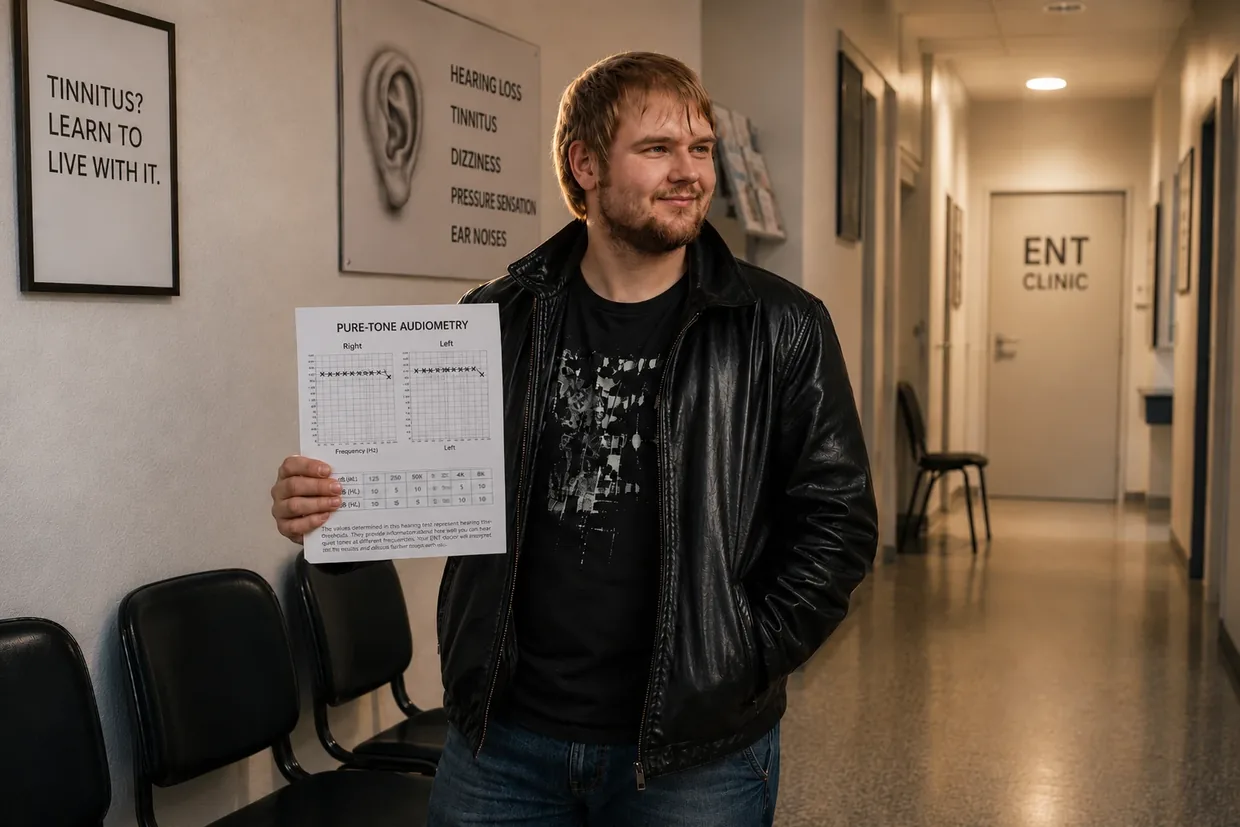
Only when I stepped into the soundproof booth did I realize just how severe my hearing damage really was. The room was completely cut off from outside sound—and in that silence I could hear every single sound in my ears, unbelievably loud. The test had three parts: first, determining the frequency and loudness of my tinnitus, then my general hearing ability, and finally bone conduction through the skull—the headphones were placed below or above my ears for that; I don’t remember exactly anymore. Then: back to the waiting room.
The Verdict: “Learn to Live with It”
After a short while, he called me back in, and this time we had a longer conversation. Holding the test results, he explained in a serious, firm tone that I’d done slight but permanent damage to my hearing by going to the club, and that nothing could be done about it.
For a moment, I really was lost for words. Meanwhile, he examined my ears again. A little shaky, I asked whether there was any chance at all of putting it right. Again, slightly exasperated: “You have to learn to live with it. Don’t listen for it, distract yourself, put on headphones.” When I asked—in hindsight, absurdly—whether I could keep going to clubs: “Yes, that won’t cause any problems.” With that, he said goodbye and left the room.
The Vow
Stunned and pretty crushed, I left the practice with the test results in my hand. On the way home, only one thing was going through my head: there’s no way I’m living with this for the rest of my life. I swore to myself: I’ll try everything imaginable to get rid of the tinnitus—or I don’t want to live anymore. (That was more something I said than something I was dead serious about. Still, the state I was in was devastating.)
Once I was home, a fresh wave of hope came over me. I simply couldn’t believe that no doctor in Germany knew what tinnitus was and how to treat it. So I went straight back to the computer and wrote to more ENT practices until I had an appointment coming up soon.
“Either the tinnitus goes, or I go. I won’t let this thing dominate my life. I have to find out for myself what can be done.”
What the Internet Had to Offer

In the few days before the next appointment, I really started reading up on it for the first time—and came across an overwhelming amount of information about living with tinnitus, what was supposed to help, and what tinnitus supposedly even was:
- Cortisone & Ginkgo: Reducing inflammation and improving circulation to help the hearing recover—it sounded plausible.
- Jaw and Neck (TMD/Cervical Spine): Muscle tension was said to trigger the sounds. I could clearly change the sound myself by moving my jaw and head—but I’d picked this thing up at the club. Even then, I wasn’t quite convinced that a muscle was keeping it going.
- TRT and Masking: Covering it with other sounds. That made sense to me: I was still listening to music on the doctor’s advice, after all, and it covered the sound well, sometimes even noticeably reduced it—but after a while it always came back. More aggressive and louder than before. Why that happened was a complete mystery to me back then.
- Supplements: I laughed at those. My cousin—the one from the club, of all people—was taking one of those A-to-Z supplements back then, and I bad-mouthed him to my mother: how can anyone fall for that and throw money away on it? The body doesn’t need it, we get all of that from food. He even offered me some. All I could think was: leave me alone with that stuff. I could never have dreamed that years later, this very route would be how I got rid of my tinnitus.
ENT Doctor No. 2: Ginkgo and Half a Sentence
On the morning of my second appointment, the tinnitus was suddenly much louder—including the quiet beeping in my right ear. I couldn’t explain why. (Later, I was able to trace it back to the sound exposure: music, and white noise at night, all on medical advice.) Feeling even more weighed down than I already did, I set off.
This ENT doctor was really friendly and encouraging. The tinnitus was still quite new, he said; it would surely go away with time. He prescribed ginkgo and recommended enough sleep and exercise to improve circulation. I asked my questions. Headphones? “They’re actually beneficial for distracting yourself.” Clubs? That surprised me: I should avoid them for a few weeks for now. And the three months after which tinnitus was supposed to become chronic? “Let’s see how you’re doing over the next few weeks first.” Me: “But is it really no longer curable after that?” Him, a little taken aback: “You can also learn to compensate for it—to tune it out completely.”
There it was again, that half-sentence.
Many Weeks Passed
And so the next days and weeks passed as I hoped that waiting, ginkgo, and the doctor’s tips would make the tinnitus less intense—or get rid of it altogether. The sound went up and down. During the day, school was a good distraction. In the evenings, right up until I fell asleep, I covered it with music through headphones and white noise on YouTube—waterfalls, all evening. That made it somewhat bearable. Or so I thought.
The Second Sudden Hearing Loss: Half a Somersault in My Head
Eventually, after a few weeks, came the wake-up call. I woke up with that feeling of pressure in my left ear again. I told myself this was probably normal after sudden hearing loss, that it could come back now and then and didn’t mean anything—and drove to school. Even on the way there, I noticed I was dizzy and the pull to the left was back; staying in my lane was becoming difficult. It would have been wiser to turn around. But the classes cost money, and I didn’t want to miss anything.
And I had the car stereo on. Really loud. My favorite songs were playing, I was really getting into them, feeling the bass vibrate through the car—people in the car next to me looked over. It felt fantastic, apart from that fucking tinnitus. Looking back, it was almost like having three-quarters of a nightclub in the car.
It started in the first class: distorted hearing, and normal sounds suddenly hurt—hyperacusis. I tried to follow the lesson and ignore it all. That didn’t work very well; I could barely understand what was being said at the front. Over the next few hours, the pressure in my left ear kept increasing. Uneasy, but without letting it show, I sat it out—until suddenly my vision started rotating vertically. Like half a somersault in my head.
It only lasted seconds. Then my vision was back to normal, but severe rocking dizziness, that familiar pull to the left, and muffled hearing on the left remained. In a panic, I tried to make sense of what was happening inside me—and above all, to make sure nobody around me noticed. Out of embarrassment. I wanted to get out, go home, right away, but I absolutely didn’t want to draw attention to myself either. So I stayed in my seat. Thank God the break wasn’t far off. When the bell rang, I grabbed my bag and got out of there.
Driving home was reckless: because of the dizziness, I had to correct my steering every few seconds. But I just wanted to get home, and it was a short drive. Looking back, it was one of the most stressful situations of all—my body was going completely haywire, and on top of that, I was afraid someone would notice the panic.
ENT Doctor No. 3: “Another Sudden Hearing Loss”—and an Offer
As soon as I was home, I didn’t hesitate this time: that very day, I booked an appointment with ENT Doctor No. 3, who could see me very soon. I told him what had happened in class. He listened, but held off on giving an opinion and sent me for a hearing test and—because I mentioned a blocked nose—a smell test. Then a test for “benign positional vertigo”: putting my head in certain positions. That changed absolutely nothing. He left the room and said a colleague would call me in again shortly.
His colleague told me, in a concerned but confident tone, that I had suffered another sudden hearing loss—which would very likely clear up within the next 14 days. And since the smell test showed that my sense of smell was worse than the average person’s, the tinnitus could also be coming from blocked sinuses. The second sudden hearing loss shocked me; the rest almost cheered me up again. Until, completely unexpectedly, she added: “You know, a lot of people fall into depression with something like this. If the symptoms persist, I’d be happy to prescribe antidepressants.”
I sat there thinking I couldn’t be hearing this right. My balance had collapsed—and psychiatric drugs were supposed to be the answer? As I left the practice, all I could think was: Please, dear God, let this whole range of symptoms disappear within those 14 days. I didn’t want to live with this, and I certainly didn’t want psychiatric drugs.
ENT Doctor No. 4: The Specialist and the Idea That It Was All in My Head
At home, I kept turning over what else I could do—and then I remembered the cortisone treatment I’d read about online. Not one doctor had even mentioned it so far. So this time, I specifically looked for an ENT doctor who specialized in sudden hearing loss and tinnitus. There was a wait for the appointment.
With the rocking dizziness, balance problems, distorted hearing, hypersensitivity, pressure in my ear, and of course the tinnitus all unchanged, I took a break from school. And spent a large part of each day on the tinnitus.de forum. There, I noticed that so many people had developed tinnitus exactly the way I had—clubs, loud music, acoustic trauma from a loud bang. And I read about what others had already tried: hyperbaric oxygen therapy (the forum’s reviews leaned negative—quickly put aside again), TRT devices (supposedly only helped in the short term, often made things worse in the long term, and weren’t covered by health insurance—crossed off my list), even surgery with an implant (for me, only as an absolute last resort—right at the bottom of the list). The word on cortisone treatment was unanimous: it does nothing. I took that on board. But back then, I still had very strong faith in doctors, and I didn’t want to spend the rest of my life regretting that I hadn’t tried a highly praised option.
Then came the appointment. ENT Doctor No. 4. Despite everything, my hopes were high again: a specialist, and cortisone treatment was still an option. He wanted to start with a hearing test—when I said I’d already had two, he dropped it because of the health insurance. So I told him. The club, the other ENT doctors, school, the somersault, everything, in one long, monotonous account. He listened without interrupting me. And then, instead of addressing any of it: “Have you ever heard of cognitive behavioral therapy?”
Me: “No, not really. What’s that supposed to mean?”
Him: “Your main problem is that you focus too much on your hearing problems. That keeps the tinnitus going and makes it worse.”
Me: “Oh, that’s interesting … ah, so that’s why I keep being told to distract myself.”
Him: “According to the latest research, chronic tinnitus is mainly the brain focusing too much on the sounds.”
Me: “But the sound started because of that night at the club, because of the sudden hearing loss, because of the damage …”
On the cortisone question: it only made sense in the first 14 days, he said. In my case, we had to assume it was a phantom sound—the brain was trying to compensate for the lost frequencies and producing a sound itself; the more I focused on it, the louder and more persistent it would become. Then TRT again, very promising. I said I’d long since tried covering it with other sounds, and in the long run that had only made my tinnitus worse. He stood up: I had to use the special devices for that, and keep using them long-term. A handshake, goodbye.
The Forum Post: A Laser, a Doctor in Regensburg—and My List
This time, I was truly desperate. Cortisone treatment, which to me was the most promising option, was off the table—and a “tinnitus expert” had just explained that my head was producing the sounds itself. The only comfort: the three months weren’t up yet. And the forum. I spent days there. Weeks.
Eventually, on the very last pages of the “Personal Experiences” section, I came across a thread called “What Really Helped You?” The first post was by a user who called himself “Tinnitus-Patient.” Only one thing had helped him, he wrote: something called low-level laser therapy. It had completely cured his tinnitus and all his other ear problems. Everything else—exactly the things I’d already been through—had done nothing for him.
That post hit me hard back then. I felt like I’d searched half the internet for doctors, clinics, studies, people with tinnitus who’d found a recognized way to cure it—and then someone just comes along and writes that he was cured by some bizarre laser therapy. Instant hope, relief, joy. And right behind it, a hefty dose of skepticism: the comments underneath tore the method apart. I was torn. It would have been so good to finally have a straw to cling to.
I googled “low level laser therapy tinnitus,” “LLLT.” And found—as with TRT and everything else—mostly bad things: dangerous, quackery. It wasn’t offered by a clinic or a “normal” doctor, only by a certain Dr. Wilden in Regensburg. Private practice, no health insurance coverage, supposedly expensive. And so, with a heavy heart, I crossed this treatment off my list too.
For now.
Rock Bottom: My Own Birthday
The days passed, and my ears grew worse. So bad that I had to cut my own birthday celebration short—about a month and a half after the first sudden hearing loss. The hyperacusis and distorted hearing were driving me crazy, and I often couldn’t understand what my friends and relatives were saying anymore: the tinnitus drowned out their words, and some letters suddenly sounded different than before—an “S” like an “F,” a “T” like a “D.” I couldn’t take it anymore and drove home.
The dizziness also kept getting worse, at times so bad that I lost my balance and was on the verge of toppling over. (It later turned out to be Ménière’s disease.)
So there I sat. No more school, no way forward. Isolated, shut off—from noise, from friends, from life. Abandoned by the doctors, who’d drilled it into me that my head was playing tricks on me and I needed antidepressants.
In the days that followed, though, I had a truly pivotal experience.
The First Pivotal Experience: The Suction Device at the University Hospital
As if I hadn’t had enough already, something else came along: a nasty inflammation of the ear canal. I should mention that I’ve had atopic dermatitis and psoriasis since childhood, especially in my ear canals—and between the damaged skin, swimming pool water, and cotton swabs to deal with the itching, I kept getting ear infections. Of all times, this happened late one weekend evening. Looking back, it was a real stroke of luck.
In pain, I dragged myself to the emergency department at University Hospital Frankfurt. And because it has a good reputation, I took the opportunity to tell the doctor my tinnitus story. He took note of it, but focused on the inflammation first—examined my ears and started suctioning out the ear canals with a tiny suction device.
And that was exactly when it happened. Within seconds, I felt the tinnitus in my left ear react aggressively to the racket right there in the ear canal. Then, in my right ear: exactly the same. That meant the idea that it was all happening in my head simply couldn’t be right. The source was still down there in my ear.
Still sitting in that chair, I decided right then to find out why my hearing reacted so strongly to loud sounds—and, more importantly, what happens when you consistently avoid noise over a longer period.
The University Hospital: Cortisone, Laptop, Gauze
When he was finished, he asked how long it had been since the sudden hearing loss. About two months. Cortisone was normally only given for acute sudden hearing loss, he said—but since it had been less than three months for me, it was worth a try. I agreed immediately. He briefly discussed it with his colleagues (I had, after all, turned up unannounced in the middle of the night), then they all agreed. My parents brought me clothes and my laptop, and I spent the night in the hospital.
Morning came, after little sleep—and as soon as I woke up, I noticed that the tinnitus was much worse again. Desperate and excited at the same time, I told myself: the connection between noise and worsening symptoms just has to be right. Then I was called to the ENT ward. ENT Doctor No. 6. A hearing test first—and sure enough, every measurement had visibly worsened: louder tinnitus, greater hearing loss, and the speech comprehension test was correspondingly bad too.
I asked this doctor too what I could do. He didn’t respond. I pressed him—and told him in no uncertain terms that if the tinnitus didn’t go away, I’d end my life. (As I said: more something I said than seriously meant. I wanted to put pressure on the doctors to do everything they could to help me.) Him: “Now, now, don’t say things like that. We’ll get this under control. We’ll start you on the infusions first.”
Back in my room, feeling completely jittery inside, I immediately sat down at my laptop. I had to find out what was going on with noise and the worsening symptoms—after all, chronic tinnitus was supposed to be all in your head. I googled something like “tinnitus worse from noise”—and landed straight back with that “Tinnitus-Patient” from the forum, this time on his own website. (The fact that he even had his own website really impressed me back then.) It explained in detail that more noise makes tinnitus and all other hearing problems worse. And there was a link to Dr. Wilden. I clicked on it.
That website was a revelation. What it said matched exactly what I’d just experienced during the suction procedure. I read it from top to bottom, over and over, growing more and more certain: this laser therapy had to work, and what Wilden was saying had to be right. My hopes were sky-high again. Except I was a student and simply didn’t have the money for what was presumably a very expensive treatment. So for now, I relied on the cortisone.
After three days, I was discharged. And amazingly, at some point during those days, the tinnitus had actually become noticeably quieter and less aggressive. I was insanely happy—but confused about exactly what had caused it.
At first, I thought it was the cortisone. But when I went back to Wilden’s website in the following days and read how crucial it was to actively seek out silence and, ideally, wear earplugs, it hit me like a bolt of lightning: ever since the treatment in the hospital, both ears had been completely stuffed with gauze! My ears had been shut off from the outside world for days—and with it, from all noise. You can imagine the emotional chaos that set off: amazement, hope, relief, fear, anger at the doctors who didn’t know things like this. But there was still too much skepticism in the mix. Maybe it was all just a coincidence. Maybe it would get worse again on its own. Maybe it really was just the cortisone.
But when the gauze came out after about a week, I could tell very clearly: my hearing had recovered a little, all the symptoms had eased. I still didn’t know what to make of it—but from then on, against all medical advice and the general opinion online, I stopped exposing my ears to any unnecessary noise. No music, no headphones, no vacuuming.

The Bang: Tinnitus Isn’t Static
A few days passed. And then came the final proof—thanks to the inflammation again. Because there was still a little inflammation left, I had to keep holding a small bottle that dispensed cream right up to my ear. And suddenly, there was a really loud bang right inside my ear (a little plug had probably formed at the opening). Within a fraction of a second, my tinnitus started howling—BUT it returned to its “normal” level in next to no time.
After that bang, I was absolutely euphoric, because I realized: tinnitus isn’t “static,” it’s dynamic. It reacts to noise—and if you go a step further and live in near silence, it gets quieter. At least in my case, with noise-induced tinnitus, that was now undeniable.
From then on, I spent as much time as possible in silence. Music, movies, seeing friends became a kind of reward—if I’d given my ears a long enough rest beforehand. And when I did, it was without headphones, very quiet, very brief.
The days and weeks passed. The months passed.
Month 8: Stuck at 25 Percent
And what can I say? The tinnitus really did get quieter from month to month, and the other hearing problems eased too. Looking back, I’d say that about eight months after the night at the club, it was a quarter quieter—and that was where it settled.
Of course, I couldn’t keep up complete silence all the time. Just one necessary car trip—200 kilometers there and back, and yes, even with the windows closed, a long drive means noise for your ears—sent the tinnitus straight back to where it had been a week earlier. A week of protecting my ears for nothing. The same went for any other kind of sound exposure (I tested all of it back then). Even trying to listen through headphones briefly in the evening at a quarter of my usual volume stopped the progress or set me back.
And then it just stopped improving. At about 20 to 25 percent improvement—whatever I tried. I avoided conversations, wore earplugs constantly, sat alone in my room all day, and had even taken out the ticking wall clock. I didn’t even go shopping anymore. All I did during those weeks was read and play video games—with the sound off, obviously. I know, this sounds pretty paranoid. But after eight months of tinnitus and six months without really experiencing anything, I was so sick of it that I just accepted that.
Still, I listened closely in the mornings, often with earplugs to get a better sense of it—and nothing changed anymore. Zero.
Eventually, a life of complete silence and no company was simply unbearable. I missed normal life so much that I started living something like it again. And the inevitable happened: everyday noise, even with earplugs, made the tinnitus noticeably louder again—even though I still strictly avoided music, vacuuming, and everything else that was loud. It was tearing me apart. I’d really thought I had the solution and just needed to stick with it long enough. I was stuck in a dilemma.
Jaw, Neck, Atlas: The Dead End
So I sat down at the computer again and searched for everything I could find about the connection between the jaw and tinnitus. Before long, I came across TMD—temporomandibular disorder. The symptoms were an exact match: clicking when chewing—check. Pain in my temples, tension headaches—check. Toothache, as my dentist had already mentioned—check. And TMD was said to often go hand in hand with cervical spine syndrome—my neck often gave me trouble too. My dentist gave me a bite splint. At an orthopedic center, a CT scan led to a diagnosis of cervical spine syndrome; the doctor assured me that once that was fixed, the tinnitus would improve too. Had he already helped other people with tinnitus? Short and to the point: “Yes.”
He prescribed a special kind of strength training (Med X) that specifically corrects muscle imbalances in the torso, shoulders, and especially the neck. So that’s what I did. With sheer determination, I stuck to both—the splint at night, regular training—and continued to avoid noise at the same time. I even wore earplugs on the way to training, with construction earmuffs over them in the car.
Many weeks passed. My jaw and neck improved. When I reached the two-month mark, reality hit: absolutely nothing had changed about the tinnitus. I didn’t understand—I could still tell that jaw and head movements made it more shrill. There had to be a connection. And then I remembered that there was still one more thing to cling to: atlas correction. I’d ruled that out while I still had the doctors behind me. Now I had no choice but to ask my parents for money.
After some back and forth, I had the money, and a few days later I drove the roughly 200 kilometers to the alternative health practitioner. And sure enough: unlike the doctors before him, he could feel and see—from the way I walked and a difference in leg length—that my atlas was clearly out of alignment. He used a special device to loosen my neck muscles, then put the atlas back into position with precise manual movements. Man, that felt strange. Can you guess what I did first? Right: listened for the tinnitus. Only, the long drive had already changed it anyway, and the practitioner said the effects would only develop over time.
While going through my medical history, I happened to mention the gastritis I’d been struggling with for almost a year. He recommended a change in diet, psyllium husks, a mineral-clay blend, and probiotics. And sure enough, that got rid of the stubborn inflammation of my stomach lining for good. That really impressed me at the time.
Once again, the months passed. I reached the first anniversary of my tinnitus, and it had been a good two months since the atlas correction—and what happened? Nothing. Well, almost nothing: my neck and jaw were practically free of symptoms. But the tinnitus wasn’t impressed. I could still affect it with my jaw and neck, yet every treatment of those parts of my body had simply done nothing for it. None of it made any sense to me anymore.
One Last Hope: A Phone Call to Regensburg
The last thing left was laser therapy. After days of going back and forth and another careful read through Wilden’s website, I made up my mind: I have to try this, even if it costs several hundred euros. After all those months of not going out or buying anything, I had at least saved up some money. So I called. They didn’t tell me anything about the cost yet—I was to email my audiogram to the practice first. So that’s what I did.
My Email, March 2012 (Translation of the Original Wording):
Dear Mr. Wilden,
First of all, thank you so, so much for your wonderful efforts to explain inner-ear damage, an area where you are far ahead of many other doctors!
I’m writing because I’d like to know how you would interpret the attached audiogram and whether regeneration with a low-level laser would be possible, and roughly how long it would take.
P.S. Thanks to your wonderful website, dasgesundeohr.de, I’ve already been able to “calm down” my tinnitus quite a bit.
P.P.S. My tinnitus consists of a quieter rushing sound and a fairly loud beeping tone in both ears—I’ve been suffering from these for a little over a year following two episodes of sudden hearing loss caused by music that was too loud.
Kind regards, Dustin Müller
The Reply, March 6, 2012 (Translation):
Dear Mr. Müller,
Thank you for your inquiry, your audiogram, and your positive feedback about www.dasgesundeohr.de and our recommendations there on actively protecting yourself against everyday sound levels.
Your audiogram shows an overload of the inner ear in the high-frequency range (4 kHz) on both sides, more on the left than the right, that is typical of your symptoms. Since this inner-ear overload in the 4 kHz range is only just above, or right at, 30 dB, the hair cells in that area are in a condition that responds very well to high-dose Low-Laser Therapy according to Dr. Wilden®. This means you can expect very good results from 5–10 days of therapy.
You are also welcome to call me about this.
Kind regards,
Dr. med. Lutz Wilden
It is important for all patients with inner-ear conditions to protect themselves against everyday sound levels.
That settled it for me. I called again, and this time I actually spoke to Dr. Wilden himself. I don’t remember his exact words—only that he assured me my ears would respond very well to the laser; it would, however, take quite a few treatments, and he could only tell me the total cost after the first sessions. The appointment was supposed to take place in the next few weeks.
It never happened. Because very shortly after that phone call, the most important thing of all happened. And it had to do with my father.
Vitamin B12: The Most Important (Accidental) Turning Point
My father had polyneuropathy at the time, a nerve disease. When medication failed to bring any improvement, he had his family doctor test his vitamin B12—on my sister’s advice. The result: a pronounced deficiency. The doctor prescribed B12 ampoules and showed him how to give himself the injections. One evening, he gave himself one right in front of me, and shortly afterward he said he was in less pain and felt warmer again. You could see it in him. One little ampoule of red liquid—and it could do that?
I couldn’t get that scene out of my head. I read up on it: B12 is the nerve vitamin. A prolonged deficiency can cause permanent nerve damage. Particularly at risk: vegetarians—I’d been one since I was 15—and people with gastritis, which I’d only just managed to get rid of. Does this torment never end? First these ears for over a year, and now perhaps permanent nerve damage? Driven by that fear, I went to my family doctor (the same one as my father). He agreed to the test. The days passed.
The result: deficiency confirmed. Not as severe as my father’s, but at the very bottom of the scale. I sat there already hearing the next sentence in my head—“Right, you’ll need injections for a while too.” But no. My family doctor simply said: “Well, you’re still within the normal range, so you don’t need injections for now.” I tried to convince him that I could slip into an actual deficiency in no time. He wouldn’t change his mind. And because my faith in doctors was still strong back then, I swallowed my frustration and trusted him. I left the practice dejected and frustrated.
That evening, my father needed his next injection, and I started turning it over in my head. Should I ask him to give me one too? But the doctor had said my level was fine—would I be risking side effects from an overdose? On the other hand, there was the threat of nerve damage. And it had helped my father in ways he could feel and I could see. And my gastritis hadn’t been cleared up by a doctor either, but by the alternative health practitioner. So I took the chance and had an injection—with a really uneasy feeling. (Important: I explicitly advise against trying this without a doctor’s guidance.)
And… wow. Within a few minutes, I felt warmth throughout my body, better circulation—just as my father had said. I also felt more balanced, clearer, mentally sharper. I went to bed relaxed.
The next morning: an absolute miracle. Seconds after waking, I noticed it—the tinnitus had become noticeably quieter. From a 25 percent improvement to a good 40. I lay there, stunned, close to tears. Shaky and euphoric, I kept asking myself every minute: What happened? What caused this?
It wasn’t long before I remembered the injection. As if on autopilot, I searched the internet for B12 and tinnitus—and actually found quite a bit: personal accounts, indications that a B12 deficiency can cause tinnitus, even a small study in which tinnitus patients with a B12 deficiency improved noticeably after receiving B12. How lucky to stumble across something like this, I thought.
But that very same day, reality hit: the tinnitus grew louder again—without me changing anything. Frustrated, I was already thinking it had just been a coincidence after all. Until, just before falling asleep, I noticed: it had become worse, but not as bad as before the injection. And the next morning: 40 percent again. And once again, it worsened over the course of the day. I couldn’t make sense of it anymore.
But one thing had stayed with me: Wilden’s website said his laser stimulated energy production in the cells—ATP. And that’s exactly what the body needs B12 for. Maybe I didn’t need the expensive laser at all. Maybe I could increase the energy through nutrients too.
Biliary Colic and Lecithin: The Building Material
While I was waiting for a high-dose multivitamin supplement from the US, I was sitting at my computer one evening as usual—and suddenly I could barely move. Severe pulling pain on the right side of my abdomen. Ugh… great, now this shit too. The internet (I was pretty practiced at using it by then) said: acute biliary colic caused by gallstones. Hours passed, it wasn’t getting any better, and late that night I dragged myself to the hospital, doubled over.
The doctor confirmed the biliary colic and advised me to stay in the hospital—they’d operate the next morning, gallbladder out. That was absolutely out of the question for me; surgery had always been my very last option. I asked about alternatives. Visibly and audibly annoyed, she said the stones could be dissolved in other ways, but they would keep coming back as long as the gallbladder was still there. After several minutes of back and forth, I signed a consent form and went home at my own risk. (Important: if you have gallstones, be sure to seek a doctor’s guidance—this is my own personal experience in an acute situation, not treatment advice for others.)
As soon as I was outside, I told myself: there has to be a solution for this too, just like with tinnitus. And sure enough, another person on a forum who’d been through it: taking lecithin granules for months had completely dissolved his gallstones, he said, and the ultrasound showed it. After my experiences with nutrients, I believed it straight away, bought a container the next day, took the recommended 30 grams—and actually felt the pressure in my upper right abdomen ease.
The real highlight came three days later. A B12 injection, then diligently taking lecithin shortly afterward—and the next day, the tinnitus was suddenly noticeably quieter again. After months of going nowhere, I was suddenly at a 60 to 65 percent improvement. Only a third of the way left to complete healing! Close to tears again, I wondered: Why lecithin, of all things? I read everything I could find about it—and came across something crucial: lecithin is an important building material for the insulation around nerves, the myelin sheath.
Wait a minute, the myelin sheath? I’d read about that before. I opened the article again: noise damages this very covering around the nerve cells—“much like the plastic insulation around a thin electrical cable being destroyed.” And B12 was said to be the most important vitamin for regenerating that layer. Oh man. So it’s not just about energy, but building materials too!
A few days later, the multivitamin supplement finally arrived. With lecithin, the injections, and the new vitamins, I hoped I now had everything. Several weeks passed. Only, what can I say? The cure I’d hoped for didn’t come. The tinnitus became less aggressive, “thinner,” and the evening worsening was much less pronounced—but it stalled at about 70 percent improvement. So a success after all. Just not the one I’d hoped for. I kept turning it over in my head: either something was still missing, or the vitamins weren’t being absorbed properly—after all, my urine had been neon yellow since I started taking the supplement.
The Breakthrough to 80 Percent
My conclusion: if the B vitamins weren’t getting through properly, I’d have to take them by injection, like the B12. After a long search, I found B1 and B2 in ampoules; B3, B5, and B8 were nowhere to be found in ampoules, so I ordered them as high-dose tablets. So there I was: B1, B2, B6, B9, B12 as injections, B3, B5, B8 as tablets, plus the multivitamin and the lecithin.
And… YES YES YES! A further reduction week after week. I think it was around month 16 or 17 when the tinnitus was actually down to only about 20 percent—an 80 percent improvement—and in the mornings, I could only hear it in complete silence. Absolutely incredible. Toward evening, it still grew noticeably louder, to about 30 to 35 percent of the original tone. But more weeks passed, and it’s not hard to guess: it stalled again. The tinnitus stayed faithful to me. I was hardly suffering from it anymore—but I wanted it gone. To finally live properly again, expose myself to louder sounds again, enjoy things that, well, are often loud.
Finally Healed: I Piled It All In
Again, I went back and forth over what might still be missing—and took another, closer look at the myelin sheath. After days of research, I had it all together. It turned out that B12 and lecithin had been far too narrow a focus. My focus. The body needed a whole range of additional nutrients to repair nerves and cells at the best pace it could manage: omega-3 (DHA/EPA), amino acids, vitamin C, the fat-soluble vitamins A, D, E, and K, minerals.
I really piled it all in: B-vitamin injections twice a week, 30 grams of lecithin three to four times a week, amino acid powder daily, 3 grams of omega-3, high-dose vitamin C, the mineral blend from Life Extension, magnesium and zinc from NOW Foods, a glass of LaVita daily, plus multivitamin tablets from Dr. Rath.
The Fade-Out: And Then There Was Nothing
With the complete nutrient package—and still as much silence as possible—the dynamic changed for good. Just as at the beginning: things were at their best in the morning, after sleep. In the evenings, the tinnitus grew louder again. But the silence ate its way ever deeper into the day: first, the tone was gone until noon. Then until the afternoon. The evening setbacks grew weaker and shorter.
And then came that one morning I’ll never forget. Within a fraction of a second of waking, I could feel it: something feels different in my head. With my heart pounding—excited like a child at Christmas—I pushed my earplugs deep into my ears. I listened… and there was NOTHING.
Morning, noon, evening—nothing anymore. Just the silence I hadn’t known for almost two years. The tinnitus was gone. Completely gone.
That feeling was indescribable. Relief, and yes: vindication. I hadn’t given up, I’d been right and the “learn to live with it” doctors had been wrong, and in the end I hadn’t even needed the expensive laser. My body had repaired it itself.
Exactly what happened in my ears—why noise made the tone louder, why silence helped, why energy and building materials made the difference—I only had an inkling of back then, and only really understood years later. Now I know: it’s about the energy supply to the hair cells. I explain that on the page about noise-induced tinnitus.
What I didn’t yet suspect that morning: many months later, a completely different chain reaction would send my body crashing into severe CFS (chronic fatigue syndrome). But I took this knowledge—that even the “incurable” can be healed—with me into the next hell.
The story isn’t over yet. What came after that first triumph was the real high-risk experiment—and the deliberate, crazy proof that my model really works.